
Showing the single result
-
-29%IN STOCK
 IN STOCK
Drills, Power & Hand Tools, Power Tools, Tools & Home Improvement
Original price was: 69,99 €.49,99 €Current price is: 49,99 €. Add to basket
Showing the single result
Cordless Drills, Combi Drills, SDS Drills, and Drill Drivers for Home and Trade Use in Cyprus
Cordless Drills and Combi Drills for General Work
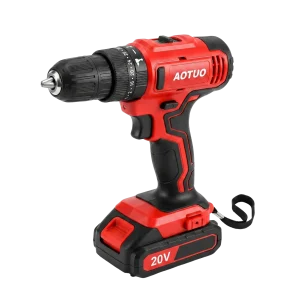
The cordless combi drill is the starting point for most buyers because it covers the widest range of everyday tasks within a single tool. In drill mode it bores clean holes through timber, metal, and plastic with standard twist bits. In screwdriver mode with the clutch engaged it drives fasteners to a set torque without over-driving and splitting the timber or stripping the screw head. In hammer mode it adds a forward percussion action that allows it to drill into brick, sand-and-cement render, and medium-density block, which covers the majority of wall fixing tasks in Cypriot homes. The distinction between a basic cordless drill and a quality combi drill matters most at the limits of the tool: a higher torque output maintains speed through hardwood and dense masonry without the motor labouring, and a variable clutch with finely spaced settings gives you the control needed for smaller screws in softwood without the risk of a runaway drive. Brushless motor technology, now standard on better cordless drills, increases both torque efficiency and battery run time compared to brushed motor equivalents, which makes a measurable difference on longer working sessions. The cordless drills in this collection are specified across 12V compact platforms for lighter work and 18V platforms for general trade use, with options across battery capacities to suit different working patterns.
SDS Drills for Masonry, Concrete, and Hard Substrates
Where a combi drill reaches the limits of its percussion mechanism, an SDS drill begins. SDS drills use a different bit retention system and a more powerful independent hammering action that drives the bit forward into the material at a higher impact rate and with considerably more energy per blow than the hammer function on a combi drill can deliver. This makes them the correct tool for drilling repeatedly into dense concrete, reinforced block, hard limestone, and the kind of thick rendered walls that older Cypriot construction commonly uses, where a combi drill in hammer mode would overheat or stall long before the hole is complete. SDS-Plus is the standard format for drilling up to around 26mm diameter in most masonry applications, handling anchor bolt fixings, conduit entries, and cable routing in walls and floors. SDS-Max is the format for larger core drilling, heavy chiselling, and breaking applications where the energy per blow needs to be substantially higher. Rotary hammer drills in the SDS-Plus class are the most practical choice for tradespeople and serious DIY users in Cyprus dealing with the substrate conditions common across the island, and the models in this collection are selected to cover the drilling diameter and depth ranges most frequently needed in residential and commercial construction work here.
Drill Drivers and Impact Drivers for Fastening Work
Not all drilling and fastening tasks need the same tool, and separating the drilling function from the fastening function often produces better results on both. A dedicated drill driver optimised for screw driving gives you finer clutch control, a shorter body for working in tighter spaces, and better balance for repetitive fastening tasks than a general-purpose combi drill provides. An impact driver takes a different approach entirely, using a rotational impact mechanism to drive long screws, coach bolts, and structural fixings into timber and engineered board without the wrist loading that a standard driver produces when the fastener meets resistance. The concussive action of an impact driver is particularly effective on the kind of dense timber fixings common in Cypriot construction joinery, and the compact body length makes it practical in the confined spaces that framing and fit-out work frequently involves. For anyone assembling timber structures, installing decking, fixing cladding, or working through high-volume screw-driving tasks, an impact driver alongside a combi drill covers both roles more effectively than a single tool trying to do both. Cy Deals stocks drill drivers and impact drivers across 12V and 18V battery platforms from manufacturers whose build quality and motor performance are consistent with daily trade use, rather than stocking budget tools dressed up in professional specifications they cannot sustain under real working loads.
Corded Drills for Sustained Power Without Battery Dependency
Cordless drilling tools have become the default for most work, but corded drills retain a clear advantage in applications that involve sustained high-load use where battery depletion becomes a limiting factor. A corded hammer drill running continuously during a full day of anchor fixing, core drilling, or drilling into reinforced concrete does not slow down as a battery charge depletes, which matters on large commercial fixing tasks and on construction sites in Cyprus where the volume of masonry drilling in a single session can be substantial. Corded drills also tend to offer higher continuous wattage ratings than cordless equivalents at the same price point, which translates to more consistent performance through the hardest substrates. For workshop use, where a mains socket is always accessible and the drill is used at a fixed bench for repetitive drilling operations, the corded format removes battery management from the equation entirely. The corded drill options in this collection cover standard two-speed drills for general use and higher-powered rotary hammer models for sustained masonry and concrete drilling, giving trade users the option to keep a corded tool in the kit for the jobs where battery-powered performance has a practical ceiling.