
Showing the single result
-
-20%PRE-ORDER
 PRE-ORDER
Rings, Electronics, Wearable Technology
Original price was: 49,99 €.39,99 €Current price is: 39,99 €. Pre Order Now!
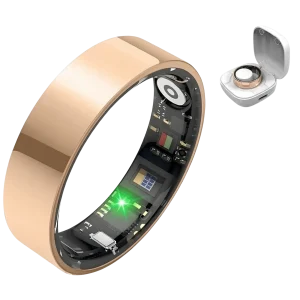
Showing the single result
Smart Rings for Sleep, Recovery, and Continuous Health Monitoring
Health Sensing and Biometric Monitoring from the Finger
The finger is among the most reliable sites on the body for photoplethysmography-based sensing, the optical technology used to measure heart rate, blood oxygen saturation, and the subtle variations in pulse timing that underpin heart rate variability analysis. Smart rings in this collection use multi-LED sensor arrays positioned on the inner band surface to capture these signals continuously, including during sleep when wrist movement and band looseness often compromise the accuracy of conventional smartwatch readings. Health metrics tracked per device include resting heart rate, SpO2, skin temperature variation, respiratory rate during sleep, and heart rate variability scores that feed into recovery and readiness calculations. The practical value of this data depends entirely on measurement consistency and algorithmic accuracy, which is why sensor specification and clinical validation references are listed per product in this section rather than replaced with general claims about health insight. For users who have found wrist-worn devices uncomfortable to sleep in, or who work in environments where a smartwatch is impractical, a smart ring closes the data gap without requiring a behavioural compromise.
Sleep Tracking and Recovery Scoring
Sleep tracking is the use case that smart rings handle most distinctively well compared to other wearable form factors, and the reason is largely mechanical. A ring does not shift position during the night the way a loosely worn wrist band can, the finger provides a strong optical signal for the sensors even in light sleep stages, and the absence of a display means there is no temptation to check notifications at 3am. Smart rings in this section track sleep duration, sleep stage breakdown including light, deep, and REM cycles, sleep timing consistency, nocturnal heart rate patterns, and overnight blood oxygen levels, feeding this data into morning readiness or recovery scores that give a single actionable number summarising overnight recovery quality. Companion app quality varies considerably across the smart ring category and is assessed per product listing, because a ring that collects good data but presents it poorly or locks core features behind a subscription paywall delivers a materially worse experience than one that surfaces the same measurements clearly and without ongoing cost. Cy Deals notes subscription requirements explicitly for every smart ring listed, because ongoing software costs are part of the real cost of ownership and should factor into the purchase decision from the start.
Activity Tracking and Daytime Health Monitoring
Smart rings are not primarily designed for real-time workout tracking in the way that GPS sports watches are, and the listings in this section are honest about where that limitation applies. Step counting, calorie estimation, activity intensity classification, and active heart rate monitoring during low to moderate exercise are well within the capability of current smart ring sensors and perform reliably across the devices stocked here. For high-intensity training where precise heart rate zones and real-time feedback matter, a dedicated sports watch remains the more appropriate tool, and the product descriptions in this section reflect that distinction rather than overstating what a ring can do during vigorous exercise. Menstrual cycle tracking and temperature-based ovulation prediction are available on several models in this section, using the continuous skin temperature data that smart rings collect with particular consistency compared to wrist-worn alternatives that sit less reliably against the skin. Daytime stress monitoring via heart rate variability trends, sedentary reminders, and breathwork guidance are also covered where the companion app supports them.
Sizing, Materials, and Practical Considerations
Smart rings require accurate sizing in a way that wrist devices do not, and getting it wrong means either a loose fit that compromises sensor contact or a tight fit that becomes uncomfortable during physical activity and finger swelling. Most smart ring purchases involve ordering a sizing kit first, and this process is explained clearly in the relevant product listings along with guidance on how finger size changes across the day and in different temperatures, both of which affect the fit of a ring worn continuously. Band materials in this collection include titanium alloy finishes in polished, matte, and brushed textures, with inner band coatings designed to minimise skin irritation during extended wear. Water resistance ratings are listed per product with depth and duration specifications, covering the difference between splash resistance and genuine swim-proof capability for those who want to wear their ring in the sea or pool. Cy Deals provides sizing guidance, material specifications, and compatibility information for every smart ring in this section, so the purchase decision accounts for fit and practicality alongside sensor capability and price.